By the third week of September, the four recreation centers scattered across Grand Lakes start easing out of pool season. The Grand Lake Swim Team's meets wind down. Lifeguard chairs come off the Rock Slide Pool deck. The line for the diving board at Hollow Trace Pool that ran three deep in July thins to nothing. If you judged the neighborhood by its pools alone, you'd guess Grand Lakes goes quiet for the winter.
It doesn't. The amenity the community is actually named for, its 27 lakes and the trail system stitched around them, is built for exactly this stretch of the calendar. Pool season is the loud part. The lake season is the long part, and it's just getting started.
What September Actually Closes
Grand Lakes runs four separate recreation centers, one for each development phase, and each one carries a competition-sized pool, a playground, and a pavilion. Two of those pools, Hollow Trace and the Rock Slide Pool, sit close enough to the trail system that in July you'll find more foot traffic circling the parking lot than the water. The splash pad and spray park follow the same seasonal rhythm as the pools. So do the lighted tennis courts, in the sense that fewer people book a court at 6 p.m. when the sun sets an hour earlier than it did in June.
None of that is a decline. It's a handoff. The neighborhood's calendar has always had two halves, a pool half and a trail half, and the trail half is the one built to outlast Houston's heat rather than compete with it.
The Water That Was Built for This Season
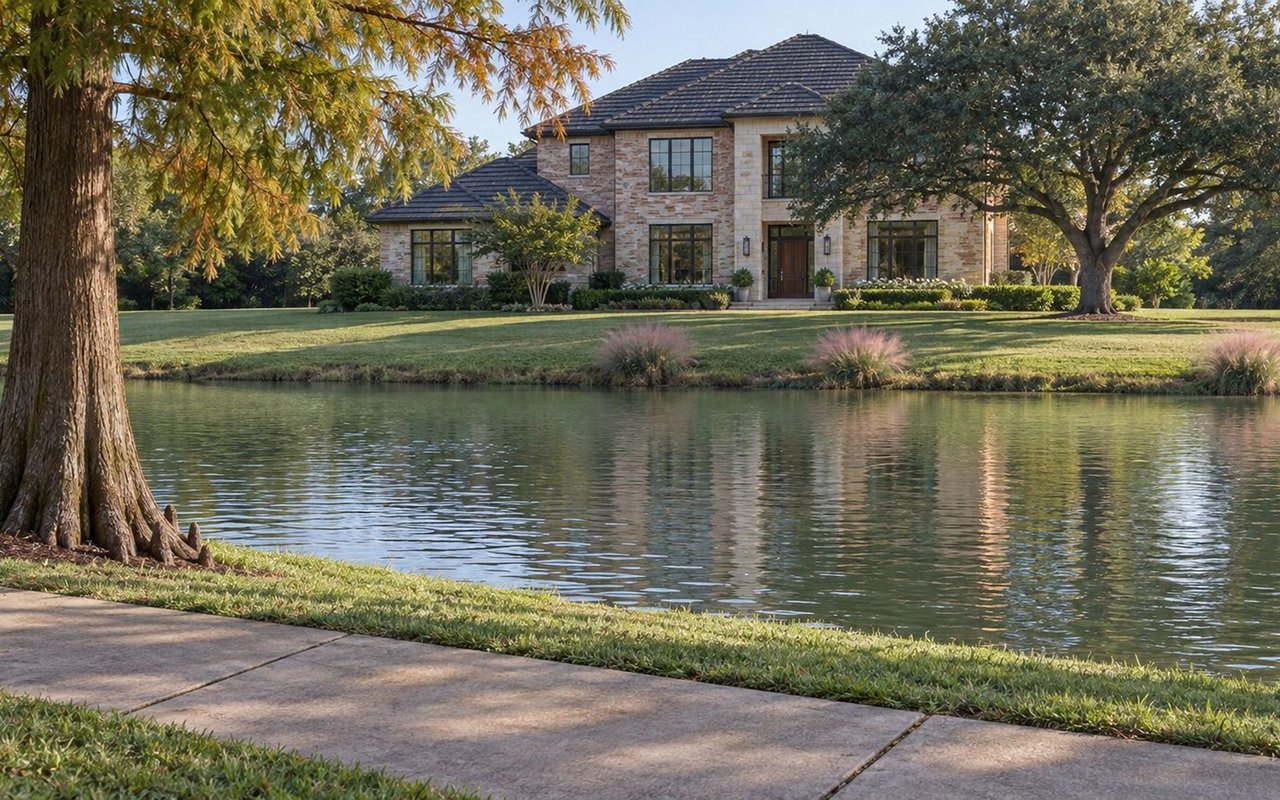
Grand Lakes takes its name from a system of 27 man-made lakes woven through all four phases of the community, and they were designed to be used, not just looked at. The lakes are stocked for catch-and-release fishing, and residents use non-motorized kayaks and canoes on the water rather than treating the lakes as scenery for a drive-by. September and October are when that water actually gets comfortable to fish and paddle. Late July surface temperatures in a shallow, sun-exposed pond don't do fish or paddlers any favors. Cooler mornings change that math.
The same is true of the trail system that connects the lakes. It's not a collection of disconnected sidewalks. The paths wind through and around the 27 lakes and link all four phases of Grand Lakes into one network, which means someone can walk, bike, or push a stroller from one end of the community to the other without ever stepping onto a road. That's a different kind of amenity than a pool. A pool is a destination. A trail system that connects four phases is infrastructure, and infrastructure gets more use, not less, once the 95-degree afternoons stop making anyone want to be outside for longer than a sprint to the car.
A short list of what shifts into higher use as the pools wind down:
- The lake-adjacent trail loops, now walkable at midday instead of only at dawn or dusk
- The dog park, where a 6 p.m. walk in September doesn't come with a heat advisory
- The putting greens and picnic pavilions, both of which see more traffic once shade isn't the only variable in deciding whether to go outside
- The community garden, moving from summer maintenance mode into fall planting
None of these amenities are new. What changes is which one is doing the work of keeping the neighborhood outside.
Four Phases, One Loop Trail
Grand Lakes was built in phases starting in the late 1990s, with development continuing for roughly two decades. Each phase centers on its own parks and its own slice of the lake system, and each has its own character, but the trail network is what ties the four together into a single community rather than four adjacent ones. More than 200 acres of the community's 1,250 total acres are set aside as parks, greenbelts, and trails, which is a meaningful share of the footprint for a neighborhood built primarily around single-family homes.
There's a piece of local trivia in the naming that most people outside the neighborhood never hear. Seven Lakes High School, the school zoned to Grand Lakes, gets its name from a combination of two communities: Seven comes from Seven Meadows, and Lakes comes from Grand Lakes. The two neighborhoods are literally written into the name their kids see on their letterman jackets. It's a small detail, but it's the kind of detail that only shows up if you've actually spent time here rather than skimmed a listing sheet.
What Fills the Calendar Once the Pools Are Covered
The fall stretch in Grand Lakes doesn't just belong to the trails. It overlaps with a set of recurring Katy-area traditions that residents build weekends around. The Katy Farmers Market runs on the third Saturday of the month from March through November in Old Town Katy, which means there are still a couple of Saturday markets left on the calendar before the year turns over. The Katy Rice Harvest Festival takes over Historic Town Square on October 10 and 11, running Saturday from 10 a.m. to 10 p.m. and Sunday from noon to 6 p.m., with vendors and the kind of small-town programming that fall festivals in Katy tend to run on. Details are posted through the City of Katy's events calendar.
October also tends to bring National Night Out gatherings to neighborhoods across the region, with block-by-block organization handled by residents and HOAs rather than the city. Grand Lakes has the kind of layout, cul-de-sacs, connected trails, shared pavilions, that makes that kind of gathering easy to pull off without much coordination overhead.
None of this requires driving out of the neighborhood. The lakes, the trail loop, the dog park, and the pavilions are already there. What changes in the fall is simply how much of the day people spend using them instead of waiting for the temperature to drop before they'll consider it.
If you've found a stretch of the trail loop that beats the rest of it this time of year, or a lake corner that's been holding fish since the water cooled off, Kelly Henderson would like to hear about it. Let's connect.